
The Difference Between London Lash Curls
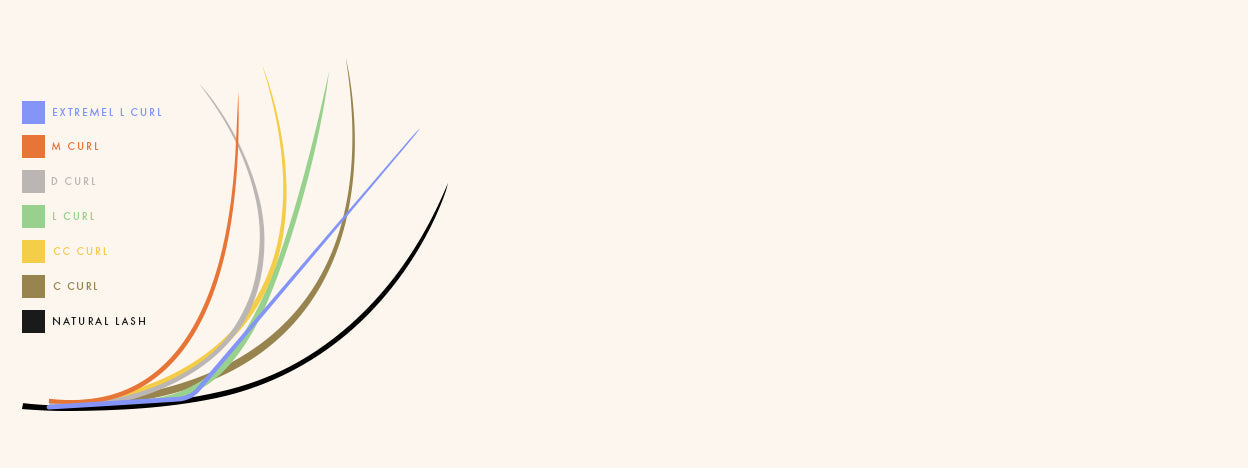

Table of Contents
Lash Curl Chart: The Difference Between Lash Extension Curls
Lash extension curls describe the shape of an extension, from its base through to its tip. Choosing the right curl means considering the natural lash direction, attachment area, eyelid clearance, and desired finish—not simply selecting the strongest curl.
As a beginner, a huge selection of lash curls may scare you at first, but trust us, they aren’t as daunting as they seem. Think of them like individuals, each with their own personalities and traits. When you’re mapping a set of eyelash extensions, with the myriad of lash curl options available, it can be a tad overwhelming to choose the right one. Here at London Lash, we believe in empowering our fellow Lash Techs with knowledge. So, let’s delve into the wonderful world of lash curls to understand their differences and when you should use them!

Lash Curl Profiles at a Glance
Before we take you through each of these stunning lash curls, here’s a quick comparison to help you understand their profiles. Use this alongside the curl diagrams and your client consultation, rather than treating any curl as a guaranteed match for a particular eye shape.
| Curl | Profile | Typical visual effect | What to assess |
|---|---|---|---|
| J | A relatively straight profile with a subtle curve towards the tip. | Soft, understated definition. | Whether the client wants subtle enhancement rather than pronounced lift. |
| B | A gentle curve, more noticeable than J curl. | Soft lift and definition. | How the extension follows the natural lash and the desired finish. |
| C | A rounded curl through the profile. | Noticeable curl with a versatile finish. | Attachment compatibility and the direction of the finished tip. |
| CC | A more pronounced rounded curl than C. | Additional curl and definition. | Whether the stronger curve suits the natural lash and eyelid clearance. |
| D | A strongly rounded curl. | A dramatic, curled appearance. | Attachment area, clearance, and how much forward projection is wanted. |
| L | A straight base followed by a distinct upward bend. | A lifted, more angular finish. | How the straight base fits the natural lash and where the bend sits. |
| M | A pronounced upward lift with a different transition from L curl. | A lifted, statement finish. | The actual product profile, attachment fit, and final tip direction. |
| LC | A straighter base transitioning into a rounded, C-like curve. | A combination of lift and a softer curved finish. | Base alignment, the position of the lift, and eyelid clearance. |
| Extreme L | A pronounced angular profile for a defined flick. | A sharp, directional finish. | Placement, attachment fit, and how the flick works within the map. |
Remember: Curl letters are not a universal measurement across brands. Compare the actual extensions and manufacturer’s diagrams when introducing a new range. Availability also varies between collections.
J-Curl: The Natural Look
The J-Curl offers a very natural-looking profile with a subtle curve towards the tip, making it a lovely choice for those who want a subtle enhancement.
How to Use: Consider it for clients looking for understated definition without going too dramatic. Check that the base suits the natural lashes and that the finished direction achieves the look your client wants.
B-Curl: The Soft Curve
Slightly curvier than the J-Curl, the B-Curl offers a soft and gentle lift. It’s a useful option when you want more curve than J without a strongly curled finish.
How to Use: Great for clients who have a slight natural curl and want to add a bit more definition, provided the extension profile fits their natural lashes.
C-Curl: The Classic Curl
The C-Curl is a popular choice among Lash Technicians. It’s super versatile and offers a noticeable rounded curl that can help create an open-eyed, refreshed look.
How to Use: Consider C-Curl when your client wants noticeable curl without an especially angular finish. For downward-growing lashes, assess the available attachment area and final tip direction rather than assuming C-Curl will always provide the right lift.
CC-Curl: The Enhanced Classic
A step up from the C-Curl, the CC-Curl provides a more pronounced curl for an enhanced finish.
How to Use: Suitable for clients who love the C-Curl but are looking for a bit more drama, where the stronger curve works with their natural lashes and eyelid clearance.

D-Curl: The Dramatic Flare
For those who love a dramatic look, the D-Curl is an option to explore. Its pronounced rounded profile gives a fabulous curled finish, making the lashes really stand out.
How to Use: Consider it for clients who want a bold and glamorous look. Check the attachment fit and clearance carefully—a stronger curl isn’t automatically a better choice for every client.
L-Curl: The Lifted Base
The L-Curl has a straight base and a distinct upward bend, creating a lifted finish without the same rounded profile as C or D curl.
How to Use: It can be useful for suitable straight natural lashes and some clients with hooded eyes. Assess how the straight base aligns with the natural lash and whether the bend clears the eyelid comfortably.
M-Curl: The Mega Lift
The M-Curl is characterized by a pronounced upward lift, making it an option for clients who want a statement finish. Its transition and tip direction differ from the rounded profile of C-Curl and the angular profile of L-Curl.
How to Use: Consider it when planning a lifted look, checking the actual extension against the client’s natural lash direction. Choose the length and placement alongside the curl to control the finished effect.
What Are LC Curl Lashes?
The LC-Curl offers a blend of L and C curl characteristics: a straighter base that transitions into a rounded, C-like curve. This combines lift with a softer curved finish, rather than the sharper transition associated with L-Curl.
How to Use: Consider LC-Curl for clients who want a balance of lift and curl, where the straighter base provides a suitable attachment fit. Assess the natural lash direction, position of the bend, and eyelid clearance before choosing it.
The important difference is the profile, rather than simply describing LC as stronger or weaker than another curl. Two extensions of the same stated length can project differently when their base shapes and curves differ.
Explore our LC curl lash extensions to check the options available.

LC Curl vs. C Curl
C-Curl has a rounded profile, while LC combines a straighter base with a curved upper section. The choice isn’t simply about wanting more curl—it’s about how the extension attaches and where you want the lift to begin.
Compare both profiles against the natural lashes. C may suit a rounded finish, while LC may be worth considering where a straighter base and lifted tip better support the intended design. Neither is automatically the right choice for every hooded or downward-growing lash line.
C Curl vs. L Curl
The main difference between C and L curl is their shape. C-Curl follows a rounded curve, while L-Curl has a straight base followed by a more distinct upward bend.
This changes both the attachment profile and the finished direction of the extension. Choose between them by assessing the natural lash, eyelid clearance, and desired map—not just whether your client wants a natural or dramatic look.
M Curl vs. C Curl
C-Curl gives a rounded finish, while M-Curl creates a more pronounced lifted profile. M can be useful when you want a different direction or silhouette, but it isn’t a direct substitute for C in every lash map.
Compare the products side by side and review the intended lengths too. Changing the curl can change how long an extension appears from the front, even when the stated length stays the same.
The Extreme L-Curl: The Ultimate Flick
The Extreme L-Curl takes the angular look to the next level, offering an even sharper, snatched, and more pronounced finish. It’s an option for those who want a dramatic Fox Eye, Cat Eye, Arrow Eye, or eyeliner look.
How to Use: Consider it for a dramatic and defined flick, particularly where it supports the planned outer-corner styling. Keep lengths and placement suitable for the natural lashes rather than relying on extra length to create the effect.

How to Choose a Lash Curl
There’s no single best lash curl for every client. Use these checks to narrow down the options before finalizing your map:
- Assess the natural lashes: Look at their direction, existing curve, condition, and ability to support the planned extensions.
- Check the attachment fit: Compare the extension’s base with the natural lash to establish suitable contact using your trained application technique.
- Consider clearance: Check how the curl will sit in relation to the eyelid and brow area.
- Agree on the finish: Establish whether your client wants soft definition, a rounded curl, an open-eyed effect, or a directional flick.
- Review length and curl together: Check the design from different angles, adjusting the map rather than assuming the same length will look identical in every curl.
Can You Mix Lash Curls?
Absolutely! Mixing lash curls is a useful approach for Lash Artists who want to craft a bespoke look tailored to individual preferences and eye shapes. By blending different curls, you can achieve a multidimensional effect that adds depth and flair. For instance, starting with C-Curl and introducing D-Curl in selected areas can add drama, while B-Curl can offer a softer transition where suitable.
The key is understanding the desired outcome and strategically placing the mixed curls for the best effect. It’s not just about the curl type; the length of the lashes also plays a pivotal role in the final look. While it’s exciting to experiment, it’s essential to maintain a balance and not overcomplicate the mix. Always consult with your client and offer expert advice to ensure a captivating yet cohesive look.
Top Tip: Record both curl and length on your lash map. When transitioning between curls, check the visible tip line so the change looks intentional rather than creating an unexpected step.

Frequently Asked Questions About Lash Curls
What Is the Difference Between C and LC Curl?
C-Curl has a rounded profile, while LC combines a straighter base with a rounded upper section. Compare the attachment fit and where the lift begins to decide which better suits the client’s natural lashes and desired finish.
Is D Curl Always Better for More Lift?
No. A stronger curve doesn’t automatically create the best result. The natural lash direction, attachment area, extension length, and eyelid clearance all influence how the curl looks and sits once applied.
Can You Mix C and D Curls?
Yes, where both profiles are suitable for the natural lashes. Plan their placement and adjust lengths where needed to create a smooth transition or deliberate contrast. Record the combination so you can maintain it during fills.
Which Lash Curl Looks the Most Natural?
J and B curls offer subtler profiles, but the overall result also depends on length, diameter, density, and the client’s natural lashes. A carefully planned C-Curl set can also look soft and understated.
Why Do the Same Curl Letters Look Different Between Brands?
Curl letters are naming conventions rather than a universally standardized measurement. Brands can differ in base length, bend position, and tip curvature, so compare the actual profiles when switching products.
Choosing the right lash curl is essential for achieving the desired look. Remember, the key is to match the curl to the client’s natural lash shape, eye shape, and desired finish. So, next time you’re in doubt, refer to this guide or consult with our amazing Customer Service team for product guidance! Our lash curls may differ from other brands, so always compare the profiles.
Every lash brand’s products are unique in their own way! Check out our wide range of gorgeous lash extensions that are developed by expert Lash Technicians, for incredible and talented Lash Technicians like yourself.
Check out these featured products


Selling Fast!


